Inflation—the Primary Theme of the Current Cycle

Should investors pay attention to media commentators or listen to the market?


  • An inflation rate in the US that rises gradually from the pre-Covid average of 1.5% to 2.5%-3% in the medium-term will not cause tangible stress to the economy or the markets.
  • May or June of 2021 should mark the peak of the present inflation cycle.
  • Market forces will gradually overcome supply chain disruptions, production bottlenecks and shortages.
  • The regime change from deflationary conditions of the past to significantly stronger economic growth with modestly higher inflation is welcomed by the markets.

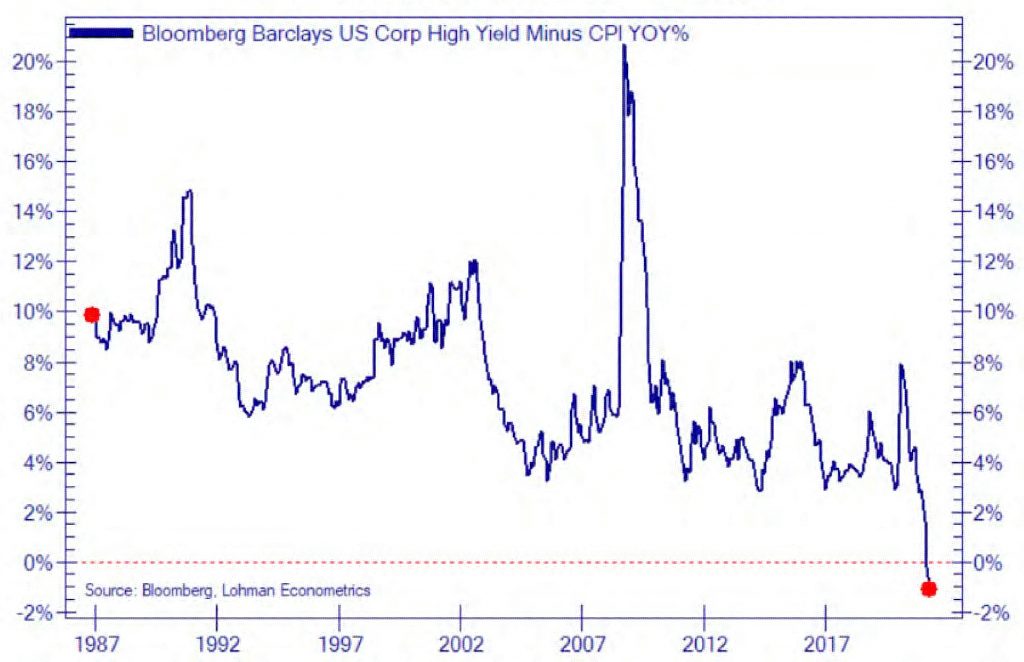
The following two events have confirmed that we are witnessing the most important shift in global macro policy since the beginning of the Ronal Reagan/Paul Volcker era some 40 years ago.  (1) Released on June 10, the US core CPI number for May was the highest in nearly three decades. The headline and core CPI inflation rose from 4.2% YoY and 3.0% YoY respectively in April to 5.0% YoY and 3.8% YoY in May, the highest levels since August 2008 for the headline rate and June 1992 for the core. (2) The June 16th Fed meeting proved to be as hawkish as could be realistically expected at this stage within realistic expectations. The most hawkish development was the Fed signaling a much quicker (2023) timeframe for raising interest rates, such that the market is now is pricing in two rate hikes (25bps), compared to zero hikes after the last meeting. The Fed made it clear that it is shifting away from managing downside risk to the economy towards upside risk to inflation expectations. Also, it has accepted the risk that inflation may not be transitory.

  1. Is the inflation increasing? US inflation will definitely be higher in 2021 versus 2020. And it is almost certainly going to be higher in the current business cycle than it was during 2009-2019. But the fact that inflation will be higher is already priced in by the market in the 1H2021.
  2. What matters now for investors, is not whether inflation is rising, but how fast and how far it will rise. In my view, an inflation rate in the US that rises gradually from the pre-Covid average of 1.5% to 2.5%-3% in the medium-term will not bring tangible stress to the economy or markets. The well-communicated-in-advance rate hikes for 2023 may represent a welcome regime change from the deflationary conditions of the past to a significantly stronger economic growth cycle that is combined with modestly higher inflation. 
  3. Highly respected economists Alatole Kaletsky from GaveKal Research and Chris Wood from Jefferies are pointing that the base effect built into 12-month comparisons suggests that May or June will mark the peak of the present inflation cycle. Monthly inflation numbers should decline dramatically from the 5%+ annualized rates reached in the US in 1H2021.
  4. Supply chain disruptions, production bottlenecks, and various other constraints hindering a return to pre-pandemic production levels should be gradually balanced by the normal operation of market forces in 2H2021 and 1H2022. 
  5. The market is obviously comfortable with the Fed’s message, as the big plunge in long-end US yields to the lowest levels since February resulted in a flattening of the yield curve while, at the same time, NASDAQ recorded a new all-time high on June 17. Thus, the market definitely seems to expect that inflation will come down in the coming months. 

Today, it does not make any sense to predict inflation by annualizing 3m, 6m or 12m trends. Any conclusions made from today’s unprecedented financial conditions will be misleading. “We live in the world, where no one ever lived before”—this assumption being at the base of our investment strategy since the end of 2017. There are a few scenarios under which inflation and the economy may go forward. What we see with investor behavior in both equity and bond markets in May-June is that they are comfortable with the inflation trend and Fed’s communication. However, investors should expect more volatility around big data releases and FOMC meetings. One thing is clear—volatility will remain high and investors should buy volatility protection.

We assign a high probability to this scenario that a successful regime change in US economic policy should result in rapid economic growth, combined with a modest increase of inflation to 2.5%-3.0% in the medium-term, over the next one to two years. 

So, a majority of economists and media commentators warn of serious inflation risks, but is the inflation truly a threat to the economy or markets? We think not!—for the next one to two years.

In short, investors should seriously consider the possibility that the market is right and financial commentators are wrong. 


Legal Disclaimer

Technology of the Future Fund

This document does not constitute an offer to anyone, or a solicitation by anyone, to make any investments in securities. This document must not be issued, circulated or distributed other than to “professional investors” as defined in Private Placement Memorandum. All information herein must be treated as confidential or legally privileged information that is intended for addressee(s) only. You are advised to exercise caution in relation to its contents. If you are in any doubt about any of the contents of the document, you should obtain independent professional advice. This material is presented solely for informational purposes and nothing herein constitutes investment, legal, accounting or tax advice, or a recommendation to buy, sell or hold a security. Information is obtained from sources deemed reliable, but there is no representation or warranty as to its accuracy, completeness or reliability. All information is current as of the date of this material and is subject to change without notice. Any views or opinions expressed may not reflect those of the firm as a whole. Third party economic or market estimates discussed herein may or may not be realized and no opinion or representation is being given regarding such estimates. This material may include estimates, outlooks, projections and other “forward-looking statements.” Due to a variety of factors, actual events may differ significantly from those presented. Indexes are unmanaged and are not available for direct investment. Investing entails risks, including possible loss of principal. Unless otherwise indicated, returns shown reflect reinvestment of dividends and distributions. Past performance is no guarantee of future results. Investing in foreign securities involves greater risks than investing in local securities, including currency fluctuations, interest rates, potential political instability, restrictions on foreign investors, less regulation and less market liquidity. This summary is not a complete list of the risks and other important disclosures involved in investing in Technology of the Future Fund, details of which can be found in the Private Placement Memorandum.



Global interest rates are at their lowest level for the last 5000 years

While the majority thinks they will never rise again, we would like to remind investors about the 3 key laws of the market:

  1. IMPERMANENCE. The main law of nature. Nothing is permanent. Every trend is bound to change. 
  2. UNCERTAINTY. Nothing is certain. 
  3. The main risk management rule: Always expect something unexpected to happen. Does this chart show a double bottom? What do you think?

Longevity—the greatest investment opportunity of all time

The primary investment theme of Technology of the Future Fund

The word “longevity” is sometimes used as a synonym for “life expectancy” in demography. Another definition of longevity describes it as “typical length of life.” We further add to this definition: “life with improved health, absent chronic illnesses and age-related diseases.” We think that the Longevity trend offers the greatest investment opportunity of all time. 

Several recent research reports have expressed the key message that we are about to experience an exponential rise in life expectancy over the next 10 years, through which we will live a lot longer and also feel younger while living longer. These reports included a few eye-opening facts and predictions:

  • “The research in aging mechanisms will get us an exponential increase in life expectancy. For example, in 2020, age 60 was equivalent of age 40 in 1980. By 2030. Ninety will be new 40.” —Dr. Michael Roizen, Chief Wellness Officer of the Cleveland Clinic.
  • Life expectancy in 2020-2030 will mark a single decade, exponential increase of up to 30 years (We can argue whether the number will be 10,20 or 30—it is still impressive). Compare this to every decade between 1850-2020, which brought us linear increases of about 2.5 year on average.
  • “I now think there is a 50% chance that we will reach longevity escape velocity by 2036. After that point (the “Methuselarity”), those who regularly receive the latest rejuvenation therapies will never suffer from age-related ill-health at any age.” —Aubrey de Grey, Strategies for Engineered Negligible Senescence (SENS), a leading voice for antiaging, aging reversal and aging damage repair.   

How do we play the longevity theme?

In our portfolio we focus on the following Biotechnology sub-sectors:

Genome Therapy

Given that genes are the foundation of all biological activity, we believe that genome medicine has transformative potential across the entire spectrum of decease categories (viruses, cancer, neurology, ophthalmology, liver disorders, etc.) and represents a USD$4.8 trillion total addressable market as well as disruption of the USD$1 trillion ( annual sales) biopharmaceutical industry (Source: Goldman Sachs Research).

Translate Bio (TBIO)

TBIO is a clinical-stage US biopharmaceutical company developing messenger RNA (mRNA)-based therapeutics, with technology that instructs cells in the body to make specific proteins that then produce an immune response. mRNA-based therapeutics is used by established COVID-19 vaccine manufacturers such as Pfizer, BioNTech and Moderna. The key difference behind the success of mRNA technology is that it “turns on” sleeping genes. French vaccine giant Sanofi has announced plans to set aside ~€400 (USD$476 million) per year in research and development efforts focused on mRNA-based vaccines. Sanofi plans to accelerate the mRNA-based vaccine portfolio, developed through its partnership with Translate Bio. Sanofi and Translate Bio have initiated a Phase 1 clinical trial evaluating an mRNA-based investigational vaccine against seasonal influenza. Translate Bio is the only company in the world which has an mRNA-based vaccine targeting influenza under development. Clinical trials of an experimental vaccine against COVID-19, which is being developed together by Sanofi and Translate Bio, showed favorable immune responses in mice and monkeys. Human clinical trials began in 2Q 2021.

Dicerna (DRNA)

DRNA’s proprietary GalXC technology is an innovative, subcutaneous, RNAi platform that enhances selectivity and knockdown of target RNA sequences. In our view, the GalXC technology is promising and the company’s partnerships with Alexion, Boehringer Ingelheim (BI), Lilly, Roche, Novo Nordisk, and Alnylam provide validation and offer economic interests across several therapeutic indications beyond rare and chronic liver disease. The company’s unique competitive advantage is described in detail here (Russian language). The company signed four collaboration agreements with big pharma players in 4Q 2020, receiving in total USD$0.5 billion of cash as a result (mkt cap was USD$1.5 billion at that time). 

DRNA management describes their very interesting business model as “centered around retention of commercial rights to core programs with opt-in rights to select collaboration programs.” For each core program, DRNA may opt-in after clinical data have been generated by the partner, limiting DRNA’s clinical development capital at risk in these programs. Upfront and milestone payments from these collaborations fund development and commercialization of core programs. We think the company is a disruptor and a likely acquisition target. Two key points: 

  1. In June 2020 the company achieved a major breakthrough by hitting the main target in their clinical studies.
  2. Their key approach— “turning off” the damaged gene—does not have any negative consequences. 

Weight Loss

According to a major study published by McKinsey in 2014, obesity is one of the three top social burdens generated by humanity’s contemporary social lifestyle. The global aggregated costs associated with being overweight and/or obese are significant, standing at USD$2.0 trillion. The number of obese (BMI >30) or overweight (BMI >25) people has exceeded 2 billion. Also, there are significant social costs: 2.8 million out of a total 59 million deaths globally per year are tied to obesity. These economic and social burdens are only expected to increase, with 41% of the global population projected to be overweight or obese by 2030. The US is experiencing among the most dramatic increases in obesity prevalence. According to the National Health and Nutrition Examination Survey, more than a third of the adult population (or roughly 88 million) is now estimated to be obese, with another third being overweight. (Source: Nordea research).

Saniona (SANION)

Saniona is a Swedish biopharmaceutical company focused on the development of treatments for rare diseases in patients. Saniona’s lead asset is Tesomet, developed to treat two rare eating disorders—hypothalamic obesity (HO) and Prader-Willi syndrome (PWS, uncontrolled hunger). PWS and HO both present symptoms of morbid obesity and hyperphagia (an insatiable craving for food), the latter being a potentially life-threatening symptom, for which there is a lack of effective therapies. The company has proved that its primary product works and will undoubtedly explore whether therapeutic uses can be expanded to cover other obesity-related issues.

Online Healthcare/Telemedicine Market in China

Chronic disease management will rely heavily on online channels, as many regular follow-up visits and prescription renewals can be completed online. In recent years the incidence of chronic diseases in China has shown a clear upward trajectory, mainly due to the accelerated increase in life expectancy. China’s chronic disease management market is nearly Rmb4.5 trillion in 2019, accounting for ~70% of total healthcare expenditures in China.

There are quite a few interesting Big Picture trends in China: 

  • Online Medical Consultation Market CAGR 2020-2030: 37%.
  • Online Healthcare Market CAGR 2021-2030: 30%.
  • Online Pharmacy CAGR 2021-2030: 19%. 
  • Some policy catalysts are expected over the next 12 months (May 2021- May 2022) that should clarify online prescription drug sales and prescription verification.
  • Total market size of prescription drug e-commerce CAGR 2020-2030: 23%, would reach 13.5% of total prescription drug sales.
  • JD Health and Ali Health combined total GMV could account for 80 % of the total online retail pharmacy market by 2025.

JD Health

JD Health is a key leader in the China online pharmacy industry, ranking 1st in total revenues generated by the online pharmacy sector. It also receives strong support from its parent company in terms of traffic and supply chain capability, with the latter typically viewed as an essential competitive advantage. We expect its online pharmacy to benefit from a significant push into online medical services, which will maintain fast growth going forward. The company has a mature “drug+service” business model. JD Health is one of the first movers in the industry to focus on both online retail pharmacy and medical service businesses, and was the largest online pharmacy in terms of revenue in 2019, a position maintained in 2020. The company has been firmly investing in the online medical service business by expanding its in-house medical team, cooperating with external renowned doctors, and setting up health management platforms. We think the medical service platform will help the company win more customers and prescription drug sales share.  As the number of users further increase with the development of the “drug+service” model, the platform of JD Health will become even more valuable with increased bargaining power over upstream suppliers, which will further expand scale effect.

Legal Disclaimer

Technology of the Future Fund

This document does not constitute an offer to anyone, or a solicitation by anyone, to make any investments in securities. This document must not be issued, circulated or distributed other than to “professional investors” as defined in Private Placement Memorandum. All information herein must be treated as confidential or legally privileged information that is intended for addressee(s) only. You are advised to exercise caution in relation to its contents. If you are in any doubt about any of the contents of the document, you should obtain independent professional advice. This material is presented solely for informational purposes and nothing herein constitutes investment, legal, accounting or tax advice, or a recommendation to buy, sell or hold a security. Information is obtained from sources deemed reliable, but there is no representation or warranty as to its accuracy, completeness or reliability. All information is current as of the date of this material and is subject to change without notice. Any views or opinions expressed may not reflect those of the firm as a whole. Third party economic or market estimates discussed herein may or may not be realized and no opinion or representation is being given regarding such estimates. This material may include estimates, outlooks, projections and other “forward-looking statements.” Due to a variety of factors, actual events may differ significantly from those presented. Indexes are unmanaged and are not available for direct investment. Investing entails risks, including possible loss of principal. Unless otherwise indicated, returns shown reflect reinvestment of dividends and distributions. Past performance is no guarantee of future results. Investing in foreign securities involves greater risks than investing in local securities, including currency fluctuations, interest rates, potential political instability, restrictions on foreign investors, less regulation and less market liquidity. This summary is not a complete list of the risks and other important disclosures involved in investing in Technology of the Future Fund, details of which can be found in the Private Placement Memorandum.